
Case Study:
EC-Drill® Enables Casing Elimination in Deepwater Wells in the Gulf of Mexico
Executive Summary
In a deepwater well in the Gulf of Mexico characterized by a narrow operating window and complex well architecture, EC-Drill® enabled elimination of a planned liner section by leveraging the Dual Gradient effect.
The result:
- Extended drilling sections
- Simplified well design
- Reduced operational time
- Lower casing and liner costs
This case demonstrates how EC-Drill® enables a different approach to pressure management by reshaping the pressure profile to better match the well’s operating window.
The Deepwater Challenge: Why Are Multiple Casing Strings Required?
What makes deepwater wells difficult?
Deepwater wells are often characterized by:
- Narrow pressure margins between pore pressure and fracture gradient
- Multiple casing and liner set points
- Increasing complexity with depth
- High cost per additional casing string
- Extended drilling and completion timelines
The challenge is not unique to deepwater alone, but becomes more pronounced due to well depth and pressure constraints.
When the operating window narrows with depth, conventional drilling requires multiple casing points to stay within safe pressure limits.
Result:Increased number of sections, higher complexity, and increased cost.
Learn more: EC-Drill® Dual MPD system
Plot 1 – Deepwater Operating Window and Resulting Casing Scheme
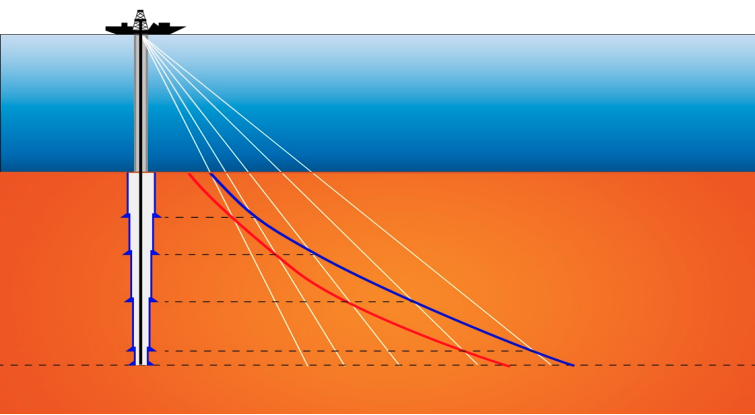
Figure 1 – Conventional pressure profile: Illustration of the drilling pressure environment showing pore pressure (red), fracture gradient (blue), and hydrostatic pressure profiles (white) for different mud weights in conventional drilling.
As depth increases, the operating window narrows, making it difficult to maintain a single mud weight within safe limits. This requires multiple adjustments in mud weight and leads to additional casing or liner set points.
In this example:
- The pressure window narrows significantly with depth
- Different mud weights are required for each section
- Multiple casing/liner set points are introduced
Each additional casing string increases:
- Rig time
- Material cost
- Operational complexity
This has traditionally been accepted as standard well design practice.
The Solution: Using the Dual Gradient Effect to Extend Sections
How EC-Drill® changes the pressure profile
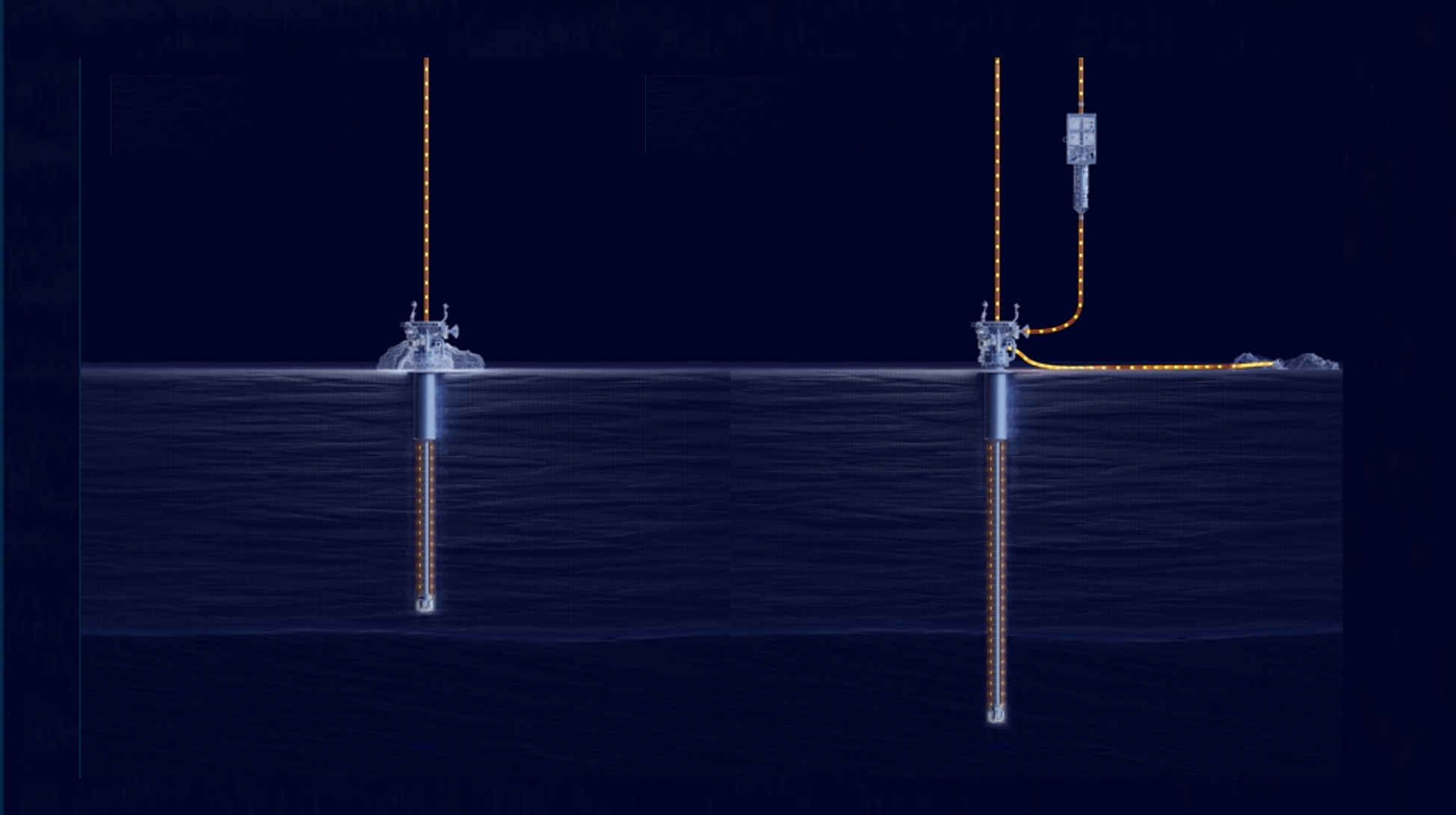
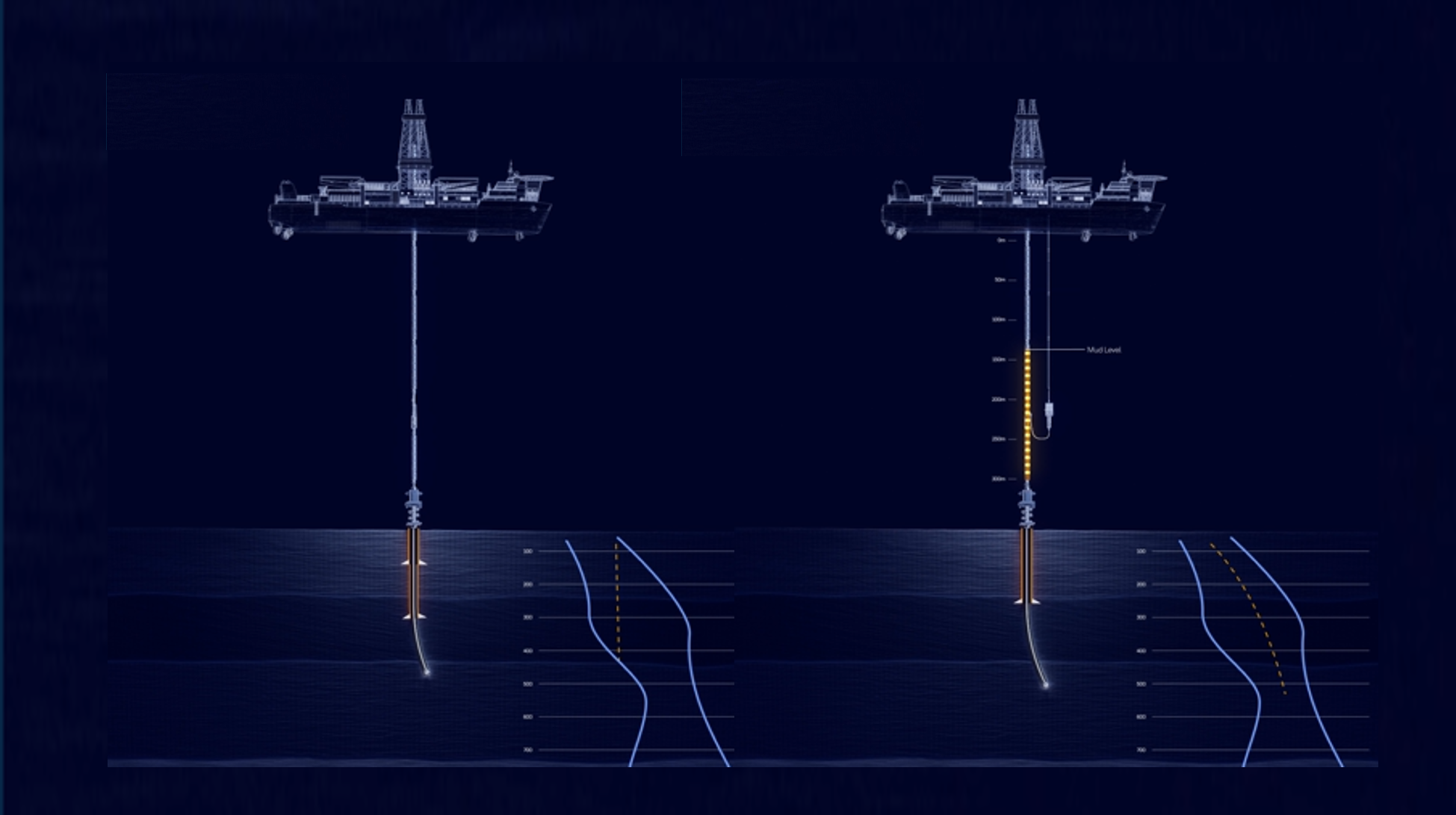
EC-Drill® creates a Dual Gradient effect by lowering the riser fluid level, effectively shifting the starting point of the hydrostatic column.
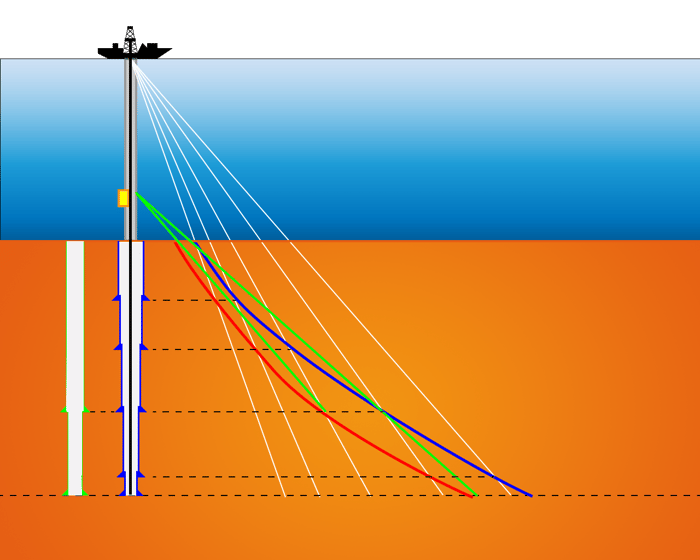
Figure 2 – EC-Drill® modified pressure profile: This illustration shows how EC-Drill® modifies the pressure profile in the well.
Compared to conventional hydrostatic pressure profiles (white lines), the adjusted pressure profile (green) better follows the operating window defined by pore pressure (red) and fracture gradient (blue).
This enables:
- Improved alignment with the operating window
- Reduced need for multiple mud weight changes
- Extension of drilling sections
- Potential elimination of casing or liner sections
Explore: EC-Drill® Controlled Mud Level technology
Plot 2 – Extending Sections Using the Dual Gradient Effect
/EC-Drill/Dual%20Gradient%20GOM_2-1.png?width=354&height=453&name=Dual%20Gradient%20GOM_2-1.png)
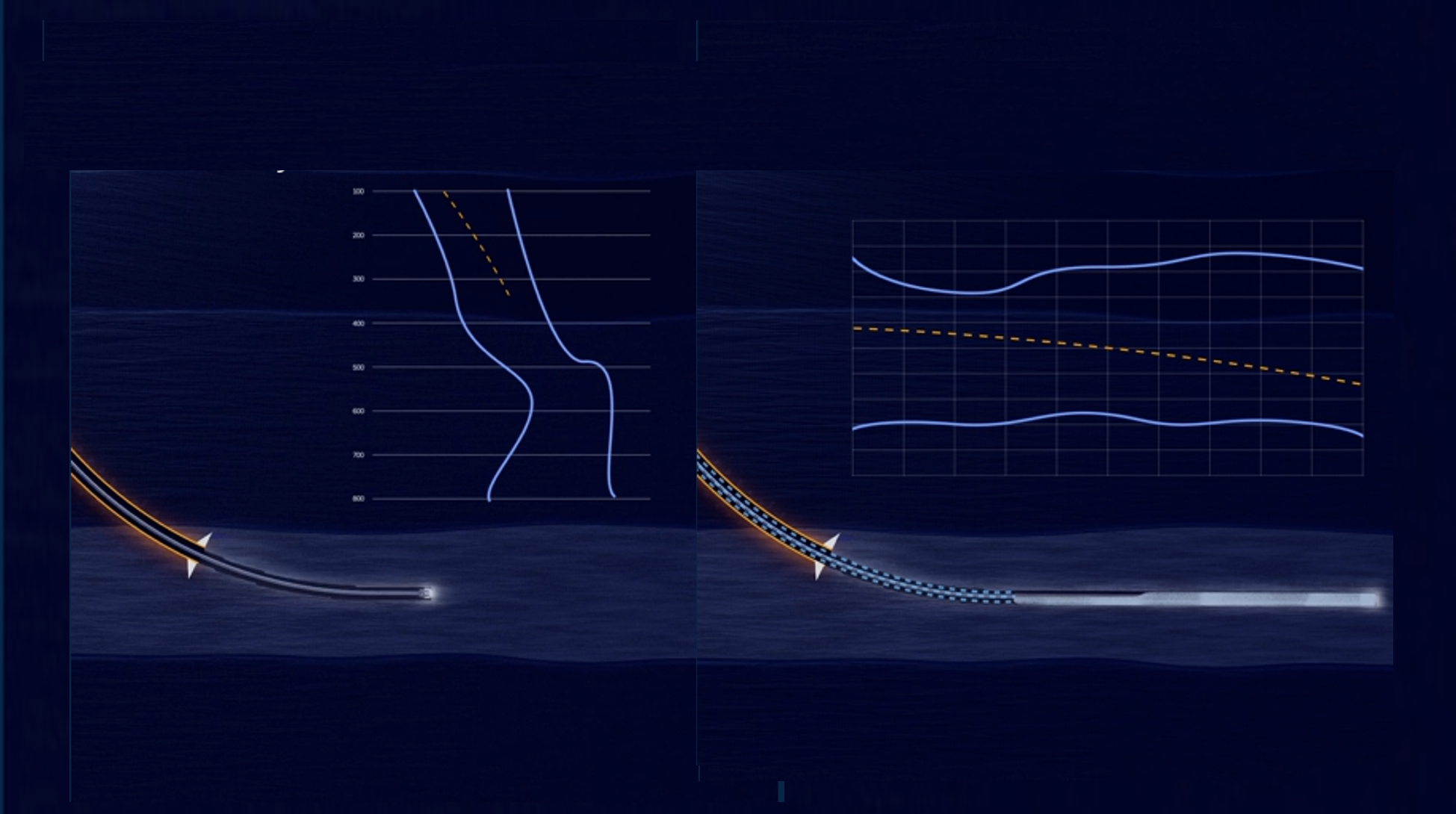
Figure description: Comparison of conventional mud weight and EC-Drill® Dual Gradient pressure profile, illustrating how liner sections can be eliminated by extending drilling intervals.
The comparison shows:
- Conventional drilling requiring liner installation
- EC-Drill® enabling extended sections
- Reduced need for casing strings
In some cases, once the riser level is set at a reduced level, sections can be drilled without continuous CBHP operation.
Case study: EC-Drill® Dual MPD influx management
Challenge Solved: From Reactive to Engineered Well Design
By applying EC-Drill®, the well design can be fundamentally simplified.
Key outcomes:
- Liner and casing strings can be reduced or eliminated
- Sections can be extended beyond conventional limits
- Well architecture becomes less complex
- Time to drill and complete is reduced
Even in scenarios where fracture gradient at the shoe is lower than pore pressure deeper in the section, EC-Drill® enables controlled drilling and completion.
This represents a shift from reactive pressure management to engineered pressure profile design.
EC-Drill®: More Than Conventional MPD
EC-Drill® is not limited to conventional MPD approaches such as CBHP.
It enables:
- Dual Gradient drilling
- Drilling in negative operating windows
- Section extension
- Pressure profile optimization
It functions as:
- An enabler for wells that would otherwise be difficult or not feasible to drill
- An optimizer for improving efficiency in wells that are already drillable
Watch the Technical Webinar
Explore how EC-Drill® Dual MPD is putting an end to frequent casing and liner installations in deepwater drilling.
👉 Watch the webinar: Deepwater MPD – Introducing EC-Drill® Dual MPD
Conclusion
EC-Drill® enables a different approach to deepwater well design by leveraging the Dual Gradient effect.
By reshaping the pressure profile, it becomes possible to:
- Reduce or eliminate casing and liner strings
- Extend drilling sections
- Simplify well architecture
- Reduce overall well cost
Want to know more?
Do you have questions regarding this case study or any of our products?
Please don't hesitate to get in touch.