
%20(1).png?width=1948&name=Well%20Diagram%20-%20Top%20Hole%20Section%20(without%20CTS)%20(1).png)
Case Study:
EC-Drill® Instant Kick Detection Proven on Deepwater Gulf of Mexico Well
In a deepwater exploratory well in the Gulf of Mexico, EC-Drill® Controlled Mud Level (CML) Managed Pressure Drilling demonstrated instant kick detection capabilities — identifying influx events up to 40–60 seconds earlier than conventional flow-out measurements and 20 seconds earlier than pit volume systems.
For operators drilling in uncertain pore pressure regimes, this represents a significant safety and well control advantage.
Project Overview
Location: Gulf of Mexico
Operator: Multi-national operator
Application: Deepwater exploration
Service: EC-Drill® Managed Pressure Drilling with Instant Kick Detection
Enhanced Drilling provided EC-Drill® MPD services to support drilling operations in a challenging deepwater environment with unconfirmed pore pressure regimes.
The Challenge: Kick Detection in Deepwater Environments
Deepwater exploration wells present unique well control challenges:
- Uncertain pore pressure windows
- Oil-based or synthetic mud systems
- Narrow operational margins
- High likelihood of connection-related kicks
Conventional kick detection methods — including flow-out and pit volume monitoring — often identify influx only after measurable volume changes have occurred.
In deepwater wells, even small delays in detection can significantly increase well control complexity.
Explore: EC-Drill® Managed Pressure Drilling System
Why Conventional Kick Detection Has Limitations
Traditional kick detection relies primarily on:
- Flow-out measurements (Coriolis meters)
- Mud pit volume totalizers
- Surface volume tracking
These systems detect influx based on observed volume changes at surface, meaning:
- Influx must accumulate before detection
- Response time is inherently delayed
- Larger volumes may enter the wellbore before intervention
In high-cost deepwater wells, this delay increases operational risk and well control exposure.
The EC-Drill® Solution: Instant Kick Detection
To improve detection response time, the operator implemented EC-Drill®’s optional Instant Kick Detection service.
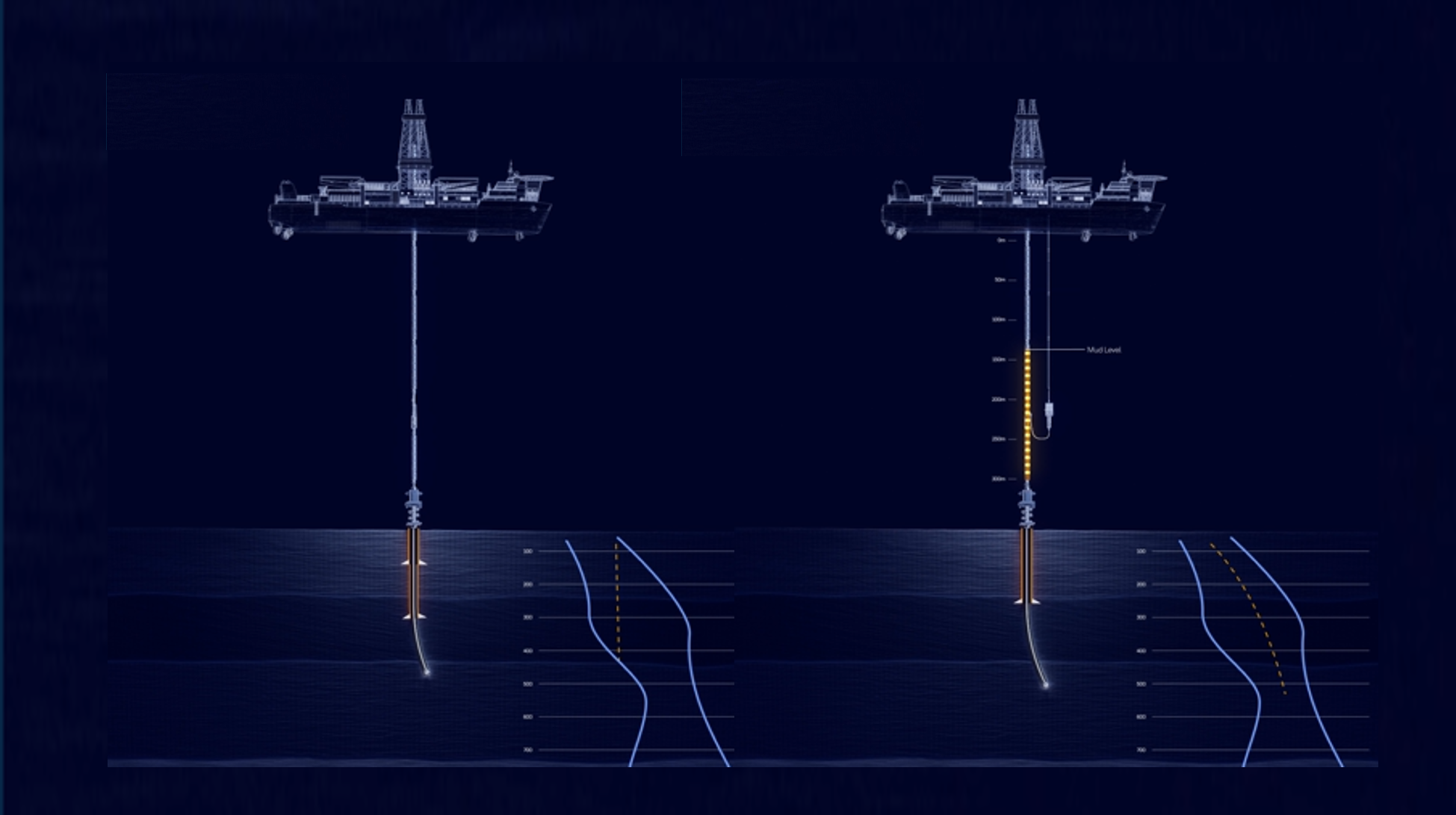
Unlike conventional systems, EC-Drill® uses:
- Pressure monitoring in the Riser
- Subsea Pump performance analytics
- Real-time dynamic modeling
This enables anomaly detection before measurable surface volume changes occur.
Webinar On-Demand: Watch the EC-Drill® rig integration webinar
Proven Performance: 40–60 Seconds Faster Detection
During both kick drills and live drilling operations, EC-Drill® demonstrated:
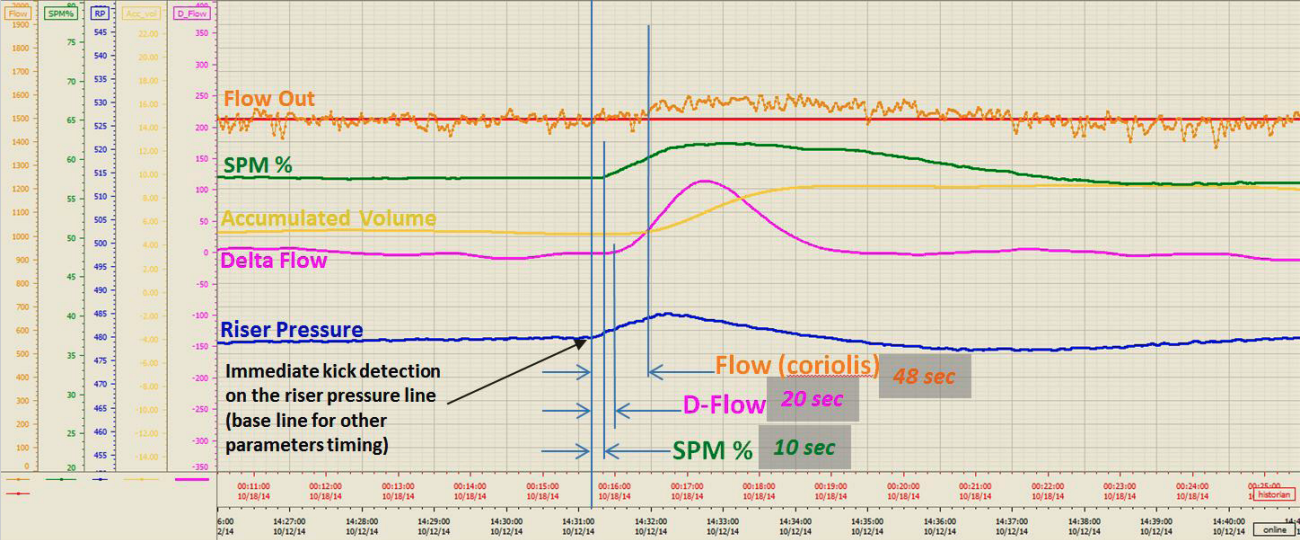
- Immediate influx detection via riser pressure sensor
- Pump speed response within 10 seconds
- Flow increase detected by Coriolis 48 seconds later
- Detection 40–60 seconds earlier than flow-out methods
- Detection 20 seconds earlier than pit volume systems
Figure 1. Influx detected immediately by the riser pressure sensor (blue), followed by pump response (green) after 10 seconds. Conventional flow-out measurements detect the event 48 seconds later.
Additional reading: CCS, SBP, CML - A Comparison Guide
Operational Impact: Reduced Risk and Enhanced Well Control
Early kick detection delivers measurable operational benefits:
- Reduced influx volume before response
- Improved well control margins
- Lower risk to personnel and equipment
- Earlier decision-making
- Improved monitoring during non-circulating operations
The drilling team concluded that using the riser above the pump as a “first in-line trip tank” provided more reliable and accurate detection than conventional methods.
For deepwater operations, this represents a step-change in kick detection capability.
Explore: EC-Drill® Dual MPD for challenging deepwater wellsWhy This Matters for Tough Wells
As operators move into:
- Narrow pressure window reservoirs
- Ultra-deepwater environments
- Complex well architectures
Conventional MPD may not be sufficient.
EC-Drill® provides a dynamic, fully integrated MPD solution capable of:
- Continuous pressure management
- Early anomaly detection
- Enhanced safety profile
Related Resources
Interested in how EC-Drill® can improve kick detection and well control in your next deepwater campaign?
-
Webinar On-Demand: Watch the EC-Drill® rig integration webinar
- Guide: CCS, SBP, CML - A Comparison Guide
Want to know more?
Do you have questions regarding this case study or any of our products?
Please don't hesitate to get in touch.